
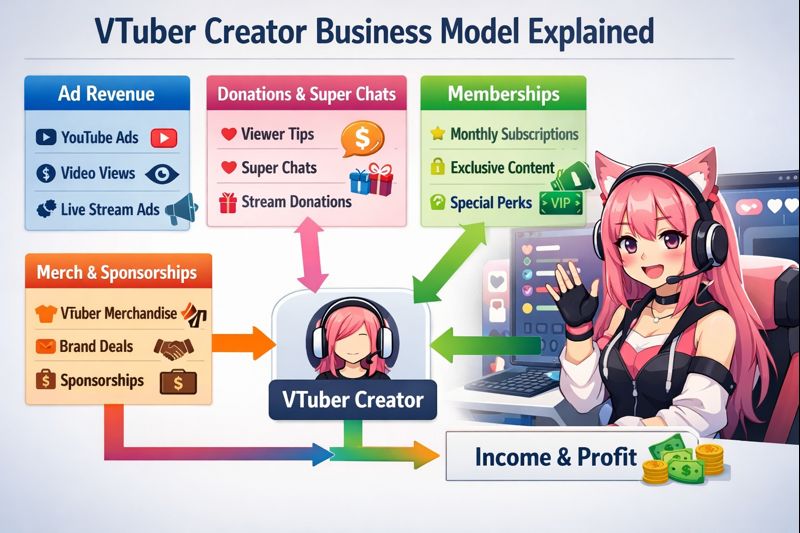
Many people think VTubers earn money only from donations.
That belief is the biggest reason VTuber careers fail.
Successful VTubers are not streamers.
They are multi-revenue digital businesses.
This guide explains in detail the VTuber creator business model, including:
- Core income streams
- Monetization layers
- Scaling systems
- Sponsor economics
- Long-term sustainability strategies
If you want VTubing to become a real career—not a hobby—this is the foundation you must understand.
Start here if you are planning a serious path:
👉 vtuber monetization methods
👉 vtuber income stability strategies
What Is a VTuber Business Model? (Simple Explanation)
A VTuber business model is:
A system that converts audience attention into multiple predictable income streams while protecting career longevity.
Unlike normal streamers, VTubers monetize:
- Character IP
- Brand identity
- Visual assets
- Community loyalty
- Merch ecosystems
- Licensing potential
A strong business model has:
- Diversified revenue
- Recurring income
- Sponsor leverage
- Scalability
- Low burnout risk
Why Most VTuber Business Models Fail
90% of VTubers fail because:
- Only rely on donations
- No recurring income
- No product strategy
- No sponsor readiness
- No long-term planning
This causes:
- Income instability
- Panic monetization
- Overstreaming
- Burnout
- Career collapse
Related survival planning:
👉 vtuber career longevity planning
👉 vtuber full time vs part time career
The 4-Layer VTuber Creator Business Model
All successful VTubers operate on four monetization layers.
Layer 1: Live Stream Revenue (Base Income Layer)
This is the entry layer.
Primary Sources
- Donations / Super Chats
- Bits
- Subscriptions
- Memberships
Income Characteristics
- High volatility
- Emotion-driven
- Algorithm dependent
- Unpredictable
Average share:
- 20%–40% of total income
This layer is:
- Good for cash flow
- Bad for stability
Layer 2: Recurring Fan Revenue (Stability Layer)
This is the most important layer for career survival.
Key Recurring Streams
1. Memberships & Subscriptions
- YouTube Members
- Twitch Subs
- Fan club systems
Benefits:
- Predictable monthly income
- High retention
- Strong loyalty
2. Patreon / Fan Platforms
Examples:
- Patreon
- Fanbox
- Ko-fi Membership
Content types:
- Behind-the-scenes
- Early access
- Voice packs
- Lore content
- Exclusive streams
This layer should generate:
30%–50% of stable monthly income
Related growth:
👉 vtuber income stability strategies
Layer 3: Product & Digital Asset Revenue (Scaling Layer)
This is where real money is built.
Digital Products
Examples:
- Voice packs
- Wallpapers
- Model presets
- Expressions packs
- Background music
- Stickers
Advantages:
- Infinite margin
- Passive income
- IP monetization
Physical Merch
Examples:
- Acrylic stands
- Keychains
- Plushies
- Apparel
- Posters
Benefits:
- Strong branding
- High fan loyalty
- Sponsor synergy
Risk:
- Inventory cost
- Logistics
- Fulfillment
Layer 4: Sponsorship & Brand Revenue (High-Leverage Layer)
This is the highest paying layer.
Types of VTuber Sponsorship Models
1. Sponsored Streams
- Fixed fee per stream
- CPM + flat hybrid
Typical rates:
- Small VTuber: $100–$500
- Mid VTuber: $500–$5,000
- Large VTuber: $10,000+
2. Affiliate Partnerships
- Game launches
- Software tools
- Equipment brands
Revenue:
- Commission based
- Performance dependent
3. Long-Term Brand Contracts
Best model:
- Monthly retainers
- Multi-campaign deals
- IP licensing
This creates:
- Income stability
- Brand prestige
- Career acceleration
Related readiness:
👉 vtuber sponsorship opportunities
👉 vtuber brand deal readiness checklist
Advanced Revenue Streams in Professional VTuber Business Models
Licensing & IP Monetization
High-tier VTubers monetize:
- Character licensing
- Game appearances
- Anime cameos
- Music rights
- Commercial mascots
This turns VTubers into:
Digital intellectual property businesses
Events & Virtual Concerts
Revenue from:
- Ticket sales
- VIP access
- Sponsorship packages
- Merch bundles
High scalability.
High brand authority.
Agencies vs Independent Business Models
Independent VTuber Business Model
Pros:
- Full revenue ownership
- Creative freedom
- Brand control
Cons:
- Self-funded
- Self-marketing
- No infrastructure
- Higher risk
Best for:
- Entrepreneurs
- Multi-skilled creators
- Long-term builders
Agency VTuber Business Model
Pros:
- Marketing support
- Sponsor access
- Production budget
- Brand power
Cons:
- Revenue split (30%–60%)
- Contract restrictions
- IP ownership issues
Related contracts:
👉 vtuber contract basics explained
👉 vtuber brand deal contract terms
The Ideal Revenue Distribution Model
Healthy VTuber income mix:
| Source | Target % |
|---|---|
| Donations & Subs | 20%–30% |
| Recurring Fans | 30%–40% |
| Products & Merch | 15%–25% |
| Sponsorships | 20%–35% |
If donations > 50% → high risk career
Business Model by Career Stage
Beginner VTuber Model (0–1,000 Fans)
Focus on:
- Donations
- Subscriptions
- Building community
Avoid:
- Heavy merch
- Early sponsors
- Complex systems
Related start:
👉 vtuber setup for beginners
Growing VTuber Model (1k–50k Fans)
Add:
- Membership tiers
- Digital products
- Affiliates
- Small sponsors
Build:
- Email list
- Discord funnel
- Brand identity
Professional VTuber Model (50k+ Fans)
Focus on:
- Long-term sponsors
- Merch ecosystems
- Licensing
- Events
- Agencies
Optimize:
- Teams
- Editors
- Managers
- Legal protection
Financial Systems Every VTuber Business Needs
1. Revenue Diversification Rule
Never rely on:
- One platform
- One income stream
- One sponsor
Minimum:
3 active income sources
2. Recurring Income Rule
Target:
At least 40% recurring monthly income
This protects against:
- Algorithm changes
- Platform bans
- Sponsor loss
3. Emergency Fund Rule
Maintain:
- 6 months living cost
- Separate business fund
- Tax reserve
Related planning:
👉 vtuber career longevity planning
Common VTuber Business Model Mistakes
Avoid these career killers:
- Relying only on donations
- No recurring income
- No sponsor strategy
- Selling merch too early
- Ignoring taxes
- No contracts
- No IP protection
How the Future of VTuber Business Models Is Changing
Major trends:
- AI-assisted production
- Virtual concerts
- IP licensing growth
- Brand-driven VTubers
- Corporate collaborations
Related industry:
👉 vtuber industry overview
👉 future of vtubers
Final VTuber Business Model Checklist
Before scaling, confirm:
✔ At least 3 income streams
✔ Recurring income active
✔ Sponsor pipeline building
✔ Digital product strategy ready
✔ Merch roadmap planned
✔ IP ownership clear
✔ Emergency fund built
✔ Legal contracts reviewed
If any fails → fix business model before scaling audience.
Final Thoughts
VTubing is not content creation.
It is a digital entertainment business.
The strongest VTubers:
- Build systems early
- Diversify revenue
- Protect IP
- Plan financially
- Scale strategically
Talent attracts fans.
Business models build careers.
Design yours carefully — your future depends on it.