
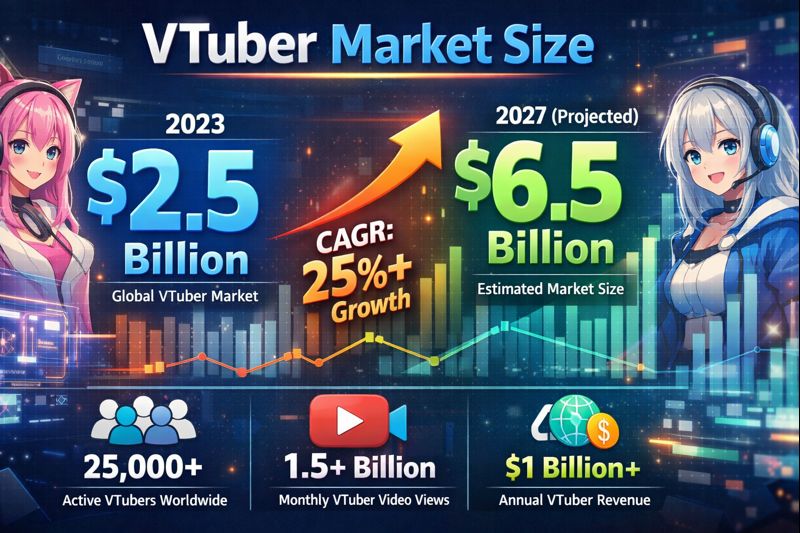
The VTuber market has grown from a niche online trend into one of the fastest-expanding sectors in the global creator economy.
What started with a handful of Japanese virtual idols now represents a multi-billion-dollar digital entertainment industry spanning:
- Live streaming
- Music & concerts
- Influencer marketing
- Virtual influencers
- Corporate branding
- Licensing and IP
This VTuber market size guide explains:
- How big the market really is
- Where the money comes from
- Which regions dominate
- Growth forecasts through 2035
- What this means for creators, agencies, and investors
If you are planning a VTuber career or business, understanding market size is critical.
Foundation reading:
👉 vtuber industry overview
How Big Is the VTuber Market? (Current Market Size)
The VTuber market is now firmly established as a billion-dollar industry.
Global Market Size (2024 Estimates)
- Total industry value: $1.5 – $3.2 billion USD
- Annual revenue growth: 25% – 40%
- Active VTubers worldwide: 50,000 – 80,000+
- Daily viewers globally: tens of millions
Revenue sources include:
- Live streaming donations
- Memberships
- Sponsorships
- Merchandising
- Music & concerts
- Licensing & IP
Related business layer:
👉 vtuber monetization methods
VTuber Market Growth Over Time
The industry exploded after 2020.
Historical Growth Timeline
2016–2018
- Experimental phase
- Mostly Japan
- Limited monetization
2019–2020
- Agency expansion (Hololive, Nijisanji)
- YouTube algorithm boost
- COVID streaming boom
2021–2023
- Global expansion
- Indie VTuber explosion
- Corporate brand adoption
2024–Present
- Mature monetization
- Sponsorship integration
- Virtual influencers mainstream
The market now grows faster than:
- Traditional influencer marketing
- Esports
- Streaming hardware
VTuber Market Size by Region
Japan (Industry Origin & Agency Powerhouse)
Japan remains the largest single market.
Estimated share:
- 35% – 45% of global revenue
Key drivers:
- Agency dominance
- Music sales
- Concert events
- IP licensing
Major players:
- Hololive
- Nijisanji
North America (Fastest Growth Region)
Estimated share:
- 25% – 30%
Drivers:
- Indie VTuber boom
- Twitch adoption
- Sponsor budgets
- Corporate virtual mascots
Related growth system:
👉 vtuber growth & optimization guide
Southeast Asia (Highest Growth Rate)
Estimated share:
- 15% – 20%
Key countries:
- Indonesia
- Philippines
- Thailand
Drivers:
- Low entry costs
- Mobile adoption
- Strong community culture
China & Korea
Estimated share:
- 10% – 15%
Growth fueled by:
- Corporate VTubers
- AI avatars
- Brand mascots
How VTuber Market Revenue Is Distributed
Understanding revenue flow explains why this industry is so attractive.
Revenue Stream Breakdown (Global Averages)
Live Streaming Support (30% – 40%)
- Super Chats
- Donations
- Bits
- Paid messages
High-margin, stable income.
Merchandising (20% – 30%)
Top revenue driver for agencies.
Includes:
- Figures
- Plushies
- Apparel
- Voice packs
Related branding layer:
👉 vtuber branding guide
Sponsorships & Brand Deals (20% – 35%)
Fastest-growing revenue stream.
Formats:
- Sponsored streams
- Brand ambassadorships
- Product launches
Related monetization:
👉 vtuber sponsorship opportunities
👉 vtuber brand deal readiness checklist
Music, Concerts & Events (10% – 20%)
Agency-dominated segment:
- Virtual concerts
- Albums
- Ticketed events
Licensing & IP (5% – 15%)
Advanced monetization:
- Games
- Anime projects
- Virtual mascots
- Corporate licensing
VTuber Market Size by Business Model
Agency VTuber Market Share
Estimated share:
- 55% – 65% of total revenue
Advantages:
- Large concerts
- Music charts
- Merch scale
- Corporate sponsors
Disadvantages:
- High operating cost
- Revenue splits
- Talent turnover
Related comparison:
👉 vtuber agency vs indie
Independent VTuber Market Share
Estimated share:
- 35% – 45%
Fastest growing segment.
Drivers:
- Lower entry cost
- Full IP ownership
- Global platforms
- Sponsorship access
Related creator system:
👉 vtuber content strategy
Why the VTuber Market Is Growing So Fast
1. Technology Accessibility
Modern tools enable:
- Webcam tracking
- iPhone Face ID
- Free VTuber software
- Affordable models
Lower barriers = exponential creator growth.
Related setup:
👉 best vtuber software
👉 vtuber model setup
2. Creator Economy Expansion
VTubers outperform many creators in:
- Retention
- Loyalty
- Merch conversion
- Donation frequency
Related monetization:
👉 vtuber monetization roadmap
3. Corporate & Brand Adoption
Brands increasingly use:
- Virtual mascots
- Event hosts
- AI spokescharacters
This injects:
- Enterprise budgets
- Long-term contracts
- Licensing revenue
VTuber Market Forecast (2025–2035)
Short-Term Forecast (2025–2027)
Expected:
- Market size exceeds $5 billion USD
- Sponsorship revenue doubles
- Indie creator dominance rises
- Corporate VTubers expand
Growth rate:
- 20% – 30% annually
Mid-Term Forecast (2028–2031)
Expected:
- Virtual influencers mainstream
- Metaverse integration
- AI-assisted VTubers scale
- Major entertainment partnerships
Projected market size:
- $8 – $12 billion USD
Long-Term Forecast (2032–2035)
Likely outcomes:
- VTubers rival traditional influencers
- Virtual celebrities dominate youth media
- Corporate virtual employees common
Projected market size:
- $15 – $25+ billion USD
Who Benefits Most From VTuber Market Growth
Creators
Benefits:
- Global audience
- Multiple revenue streams
- Strong IP ownership
Related growth system:
👉 vtuber growth & optimization guide
Agencies
Benefits:
- Concert revenue
- Licensing deals
- Talent pipelines
Brands & Advertisers
Benefits:
- High engagement
- Young demographics
- Brand-safe avatars
Software & Tech Providers
Fast-growing sectors:
- Face tracking
- Motion capture
- AI avatars
- Streaming tools
Related comparison:
👉 vtuber software comparison
Challenges That May Slow Market Growth
1. Oversaturation
Problems:
- Harder discovery
- Audience fragmentation
- Creator burnout
Solution:
- Strong branding
- SEO content
- Strategy systems
Related positioning:
👉 vtuber content strategy
2. Legal & IP Risks
Issues:
- Model ownership disputes
- Licensing conflicts
- Agency contracts
Related protection:
👉 vtuber model ownership copyright and commercial use
3. Sustainability & Burnout
High workload:
- Streaming
- Editing
- Community
- Sponsors
Leading to:
- Hiatus
- Retirements
- Mental health risks
Is the VTuber Market Still Worth Entering?
Yes — but only strategically.
High success probability requires:
- Strong branding
- Niche positioning
- Multi-platform strategy
- Monetization planning
Related career system:
👉 vtuber career path guide
Final VTuber Market Size Checklist
Before investing or entering the industry, understand:
✔ Current market size
✔ Growth rate trends
✔ Regional dominance
✔ Revenue streams
✔ Business models
✔ Monetization layers
✔ Legal risks
✔ Long-term outlook
If any area is unclear, research before committing heavily.
Final Thoughts
The VTuber market is no longer experimental.
It is a high-growth, global digital entertainment economy.
Those who win long-term:
- Build IP
- Control branding
- Diversify revenue
- Think like businesses, not hobbyists
VTubers are not just creators.
They are scalable digital media companies.