AI-powered VTuber avatars are spreading fast.
They promise lower cost, faster setup, instant expressions, and automated content.
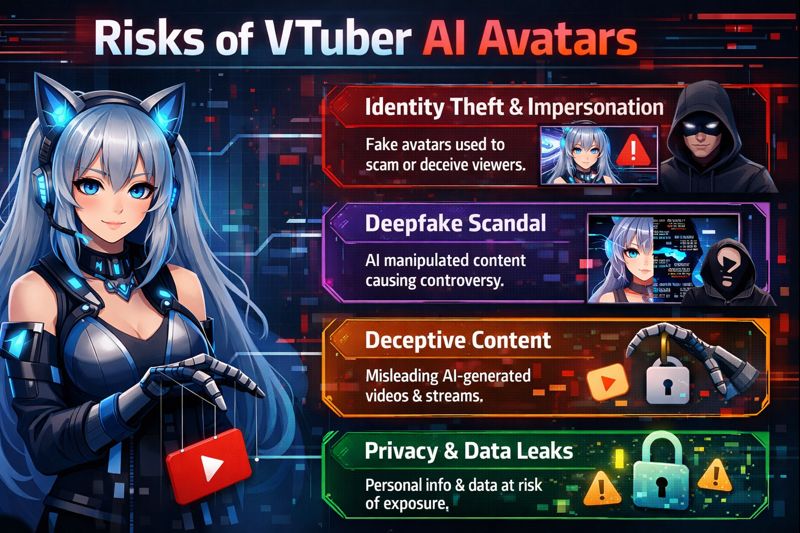
But behind the hype, VTuber AI avatars introduce serious creative, legal, ethical, and long-term career risks that many creators only discover after it’s too late.
This guide breaks down VTuber AI avatar risks clearly and honestly—so you can decide when AI helps, when it hurts, and when it can permanently damage your VTuber career.
If you’re still building your foundation, read first:
👉 vtuber brand identity
👉 vtuber career longevity planning
What Is a VTuber AI Avatar?
A VTuber AI avatar usually involves one or more of the following:
- AI-generated character art
- AI-rigged Live2D or 3D models
- AI facial animation or expression prediction
- AI voice synthesis or voice cloning
- AI-assisted autonomous streaming or posting
These tools are often marketed as:
- “No artist required”
- “Instant VTuber”
- “Fully automated VTuber”
But automation changes ownership, authenticity, and control.
Why VTuber AI Avatar Risks Are Growing in 2025
AI tools are improving faster than creator protections.
Most risks come from:
- Unclear ownership rights
- Platform policy gaps
- Audience trust issues
- Long-term brand damage
Creators who rush into AI avatars often trade short-term convenience for long-term instability.
Related trend context:
👉 vtuber trends 2025
👉 future of vtubers
Core VTuber AI Avatar Risks You Must Understand
1. Ownership & Copyright Risks (The Biggest Threat)
Many AI avatar tools do not give you full ownership.
Common problems:
- You don’t own the model weights
- You can’t legally resell or modify the avatar
- The AI company can reuse or replicate your avatar
- Your character may not be copyright-protectable
Some AI avatars are not legally recognized as original works in certain jurisdictions.
This affects:
- Merch
- Sponsorships
- Licensing
- Legal enforcement
Related protection:
👉 vtuber model commission contract template
👉 vtuber digital product legal considerations
2. Brand Identity Erosion
Strong VTuber brands are built on:
- Unique design
- Emotional consistency
- Recognizable personality
AI avatars often produce:
- Generic faces
- Repetitive expressions
- Trend-driven aesthetics
This leads to:
- Weak differentiation
- Low memorability
- Audience confusion
AI avatars scale similarity, not uniqueness.
Related branding:
👉 vtuber branding guide
👉 vtuber overlay design
3. Audience Trust & Authenticity Issues
VTuber audiences value:
- Emotional connection
- Creator presence
- Consistent personality
When viewers discover heavy AI involvement:
- Trust may drop
- Emotional attachment weakens
- Donations often decline
This is especially true if:
- AI voice replaces human voice
- AI responds instead of creator
- Disclosure is unclear
Related ethics discussion:
👉 vtuber ai avatar ethics
👉 vtuber ai voice risks
4. Platform Policy & Monetization Risks
Streaming platforms are still adapting.
Potential risks:
- Future AI content restrictions
- Monetization limits
- Disclosure requirements
- Demonetization for synthetic content
Sponsors may reject:
- Fully AI-driven avatars
- Unclear ownership
- Voice cloning
Related monetization safety:
👉 vtuber monetization methods
👉 vtuber sponsorship readiness checklist
5. Legal Risk From Training Data
Many AI avatars are trained on:
- Scraped artwork
- Unlicensed models
- Public datasets without consent
If your avatar resembles:
- Existing VTubers
- Protected IP
- Licensed characters
You could face:
- DMCA takedowns
- Platform strikes
- Legal disputes
Even if you didn’t train the model, liability may still affect you.
6. Long-Term Career Fragility
AI avatar dependency creates lock-in.
If:
- The AI service shuts down
- Pricing changes
- Terms are updated
- Platform bans the tool
Your entire VTuber identity may disappear overnight.
Human-owned models = portable.
AI-locked avatars = fragile.
Related sustainability:
👉 vtuber long term creator sustainability
👉 vtuber income stability strategies
7. Creative Control Limitations
AI avatars often restrict:
- Expression tuning
- Custom poses
- Detailed emotional nuance
- Manual optimization
This impacts:
- Storytelling
- Lore building
- Performance depth
Advanced VTubers outgrow AI avatars quickly.
Related optimization:
👉 live2d vtuber model optimization tips
👉 3d vtuber model performance optimization
AI Avatars vs Artist-Made VTuber Models (Risk Comparison)
| Area | AI Avatar | Artist-Made Model |
|---|---|---|
| Ownership | Often limited | Full ownership (with contract) |
| Brand uniqueness | Low–medium | High |
| Legal protection | Weak | Strong |
| Monetization | Risky | Stable |
| Longevity | Uncertain | Long-term |
| Creative control | Limited | Full |
When AI Avatars Can Make Sense (Low-Risk Use Cases)
AI avatars may be acceptable if:
- You’re testing content ideas
- You want a temporary placeholder
- You’re experimenting before commissioning
- You clearly disclose AI use
Related planning:
👉 vtuber model budget planning
👉 vtuber setup low budget
When AI Avatars Are a Bad Idea
Avoid AI avatars if:
- You want sponsorships
- You plan merch or licensing
- You value brand longevity
- You want legal ownership
- You aim to go full-time
Related career decisions:
👉 vtuber full time vs part time career
Risk Mitigation Checklist for VTuber AI Avatars
Before using any AI avatar, confirm:
✔ Ownership terms are clear
✔ Commercial rights included
✔ Training data disclosed
✔ Platform policies checked
✔ Sponsorship compatibility
✔ Exit plan exists
If any box fails → do not commit.
How to Use AI Safely Without Killing Your VTuber Brand
Safer alternatives:
- AI for background tasks only
- AI-assisted editing
- AI scheduling tools
- AI analytics
Keep:
- Human voice
- Human performance
- Artist-owned avatar
Related tools:
👉 vtuber analytics tools comparison
Final Thoughts
AI avatars are powerful—but power without control is risk.
Short-term convenience can cost:
- Brand trust
- Legal safety
- Income stability
- Career longevity
The most successful VTubers use AI as a tool, not an identity.
Your avatar is your business asset.
Protect it.